 Author:


What Is Face Mapping — and Why Does It Still Matter?
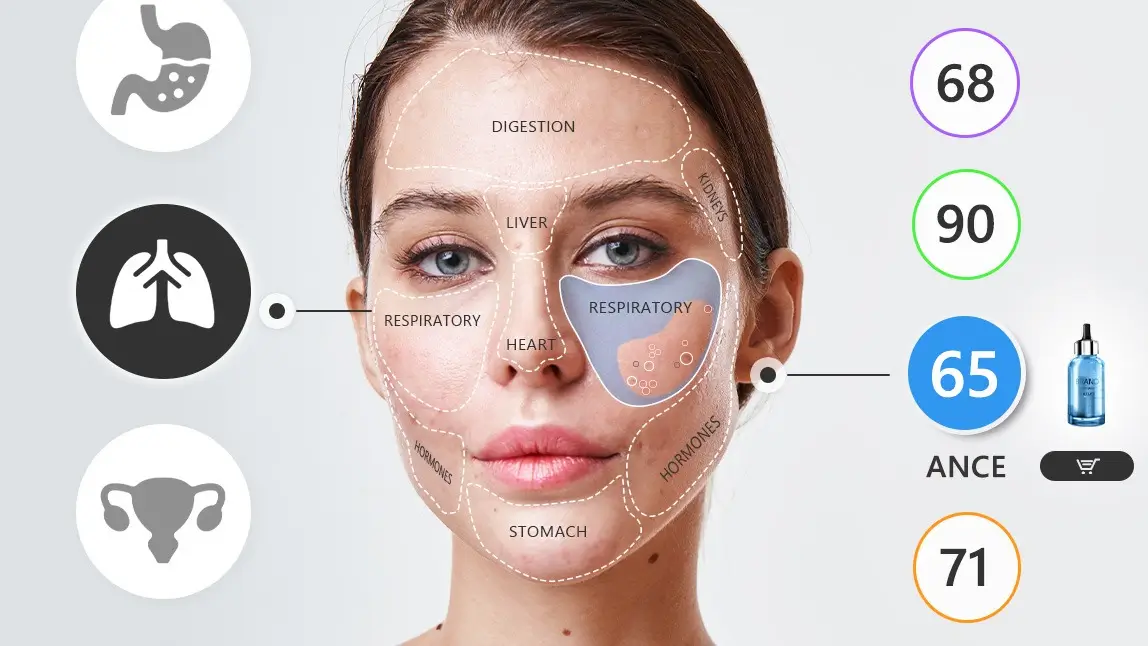
Face mapping is one of those concepts that travels well across time. Rooted in traditional Chinese medicine and Ayurvedic practice, the core idea is that different zones of the face reflect the condition of corresponding internal systems — and that skin presentations in specific areas carry diagnostic meaning beyond surface appearance.
For centuries, this framework guided how practitioners approached skin consultations: a breakout on the forehead was read differently from one on the jawline, and persistent redness on the cheeks was associated with different causes than redness across the nose. The framework wasn't always scientifically precise by modern standards, but it embedded something genuinely valuable — the idea that skin should be assessed by zone, not as a uniform surface.
What makes face mapping relevant to modern skincare businesses isn't its historical roots. It's that the underlying logic — spatially differentiated skin analysis — maps almost perfectly onto what AI-powered skin assessment does at a technical level. When an AI skin analysis system segments a face into distinct zones and evaluates conditions across each independently, it's executing the same spatial reasoning that face mapping practitioners developed intuitively.
"The reason face mapping has persisted across cultures and centuries is that it encodes a real clinical insight: the face isn't uniform. Different zones have different physiology, different exposure patterns, and different relationships to systemic health. AI skin analysis formalizes that insight with measurable precision." — Skincare technology consultant perspective
The shift from intuitive to computational face mapping is what makes AI skin diagnostic tools commercially viable at scale — and that's the development that matters for brands, clinics, and med spas evaluating this technology today.
What Face Mapping Tells You About Skin Conditions
Before examining how AI transforms the practice, it's worth understanding what face mapping actually surfaces — and why that zonal differentiation matters for product recommendations and treatment planning.
Forehead zone. In traditional face mapping, the forehead is associated with digestive health and stress — areas where lifestyle factors tend to manifest as congestion and breakouts. Modern clinical observation broadly supports the connection between sleep disruption, digestive issues, and forehead acne, primarily through cortisol-related sebum production.
Cheek zone. The cheeks are the largest surface area of the face and among the most exposed to environmental factors — UV radiation, airborne pollution, and temperature change. Persistent redness in this zone is often associated with sensitization or early-stage rosacea. Uneven pigmentation is frequently concentrated here due to cumulative UV exposure patterns.
T-zone (forehead, nose, chin). The T-zone typically has higher sebaceous gland density than the rest of the face, making it the primary site for oiliness, enlarged pores, and congestion-type acne. Understanding T-zone behavior is foundational to any skin type classification.

Jawline and chin. Hormonal acne — particularly in women — concentrates heavily along the jawline and chin. Breakout patterns in this zone are among the most reliable indicators of hormonal fluctuation and are particularly relevant for med spas offering hormonal acne treatment protocols.
Periorbital area (around the eyes). The skin around the eyes is significantly thinner than elsewhere on the face, making it the first area to show fine lines, dehydration, and puffiness. This zone requires specific treatment approaches and is a major driver of anti-aging product recommendations.
"Zone-based skin assessment changes the quality of the consultation conversation. When you can show a client a spatial breakdown of what's happening in different areas of their face — and explain the different factors driving each — the recommendation becomes much more credible and the client relationship becomes much stickier." — Medical aesthetics practice consultant
Understanding this zonal framework also clarifies why a single-metric skin assessment — "your skin is dry" or "you have some acne" — is commercially limited. The value in face mapping, and in AI skin analysis that executes it well, is the ability to produce condition-specific findings for each zone and match those findings to targeted product or treatment recommendations.
The Limits of Traditional Face Mapping
Traditional face mapping has real clinical intuition behind it, but several practical limitations have constrained its usefulness as a scalable business tool.
Subjectivity and practitioner variance. A face mapping assessment done by hand is only as consistent as the practitioner delivering it. Two estheticians evaluating the same client may reach meaningfully different conclusions about the severity of a concern, the zone it's concentrated in, or the treatment priority. In a multi-location retail or clinic environment, this variance erodes the consistency of the customer experience.
Time intensity. A thorough manual face mapping consultation — examining the skin under magnification, zone by zone, and documenting findings — takes significant practitioner time. At high client volumes, this creates a bottleneck that most businesses can't absorb without compromising either consultation depth or throughput.
Documentation limitations. Manual assessments are difficult to document in a format that supports longitudinal tracking. Without a consistent, quantified baseline, comparing a client's skin condition at intake to their condition three months into a treatment protocol requires the same practitioner to remember what they saw — an unreliable standard.
No scalability to digital channels. Traditional face mapping requires an in-person appointment. For brands with e-commerce or app-based customer relationships, there's no equivalent — which means digital customers have historically received far less personalized guidance than in-store clients.
These limitations are precisely what AI face mapping skin analysis is designed to address — and understanding them helps clarify what the technology needs to do well to deliver real business value.
How AI Skin Analysis Modernizes Face Mapping
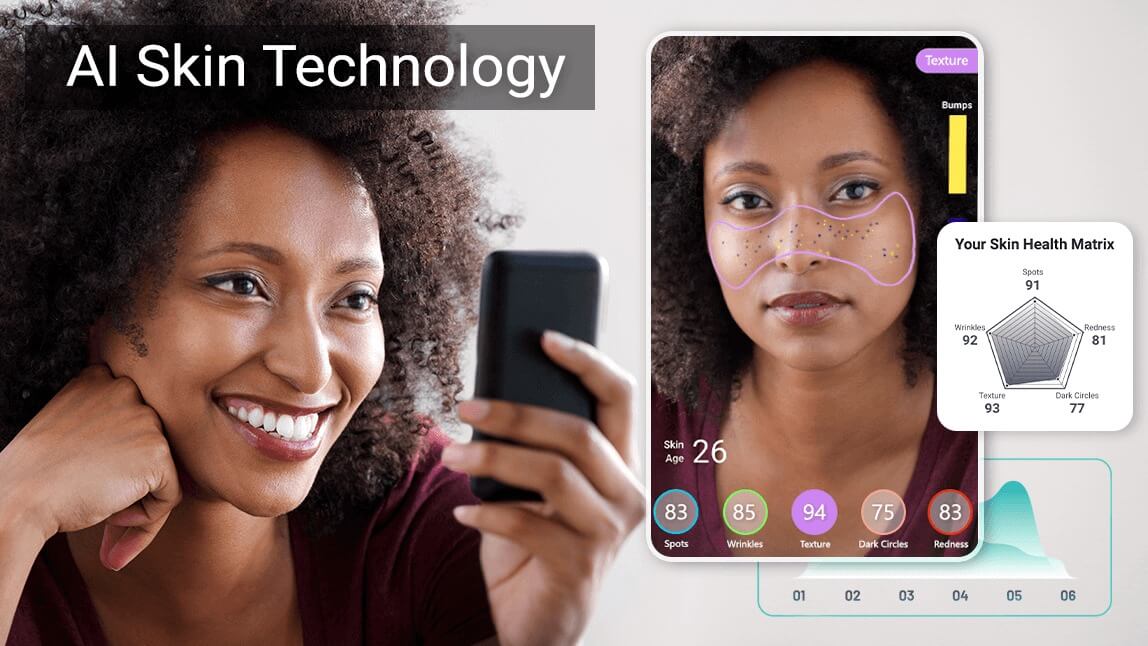
AI skin analysis platforms that incorporate face mapping logic work by applying computer vision models to high-resolution facial images — segmenting the face into distinct zones and evaluating specific skin condition metrics within each.
The output isn't a subjective clinical impression. It's a structured, quantified assessment: specific skin concerns identified, severity scored, and spatially located across the facial map. The same assessment framework applies to every user, regardless of which staff member is present or what time of day the consultation happens.
Perfect Corp.'s AI Skin Diagnostic operationalizes face mapping through a 180-degree analysis that covers the full front and lateral contours of the face — not just the frontal view that most camera-based tools are limited to. This matters because conditions like jawline acne, lateral cheek pigmentation, and periauricular redness are frequently missed in frontal-only analysis. The 180-degree coverage ensures the spatial assessment reflects actual skin distribution rather than the portion the camera happens to capture.

Before any analysis begins, the system validates three real-time capture conditions — lighting quality, facial alignment, and face position — using a live indicator that confirms when image quality meets the detection threshold. This removes the most common source of inconsistent results in deployed AI skin analysis: poor image input.
"The shift from subjective practitioner assessment to consistent, documented AI analysis doesn't diminish the consultation — it elevates it. The practitioner's time is better spent on what they're uniquely qualified to do: interpret findings, build trust, and develop a treatment relationship. The analysis itself can be handled more reliably by the system." — Beauty tech implementation strategist
Key Capabilities: What AI Face Mapping Actually Measures
Understanding what a well-built AI skin analysis platform actually measures — and how — helps businesses evaluate whether the technology will deliver the consultation quality they need.
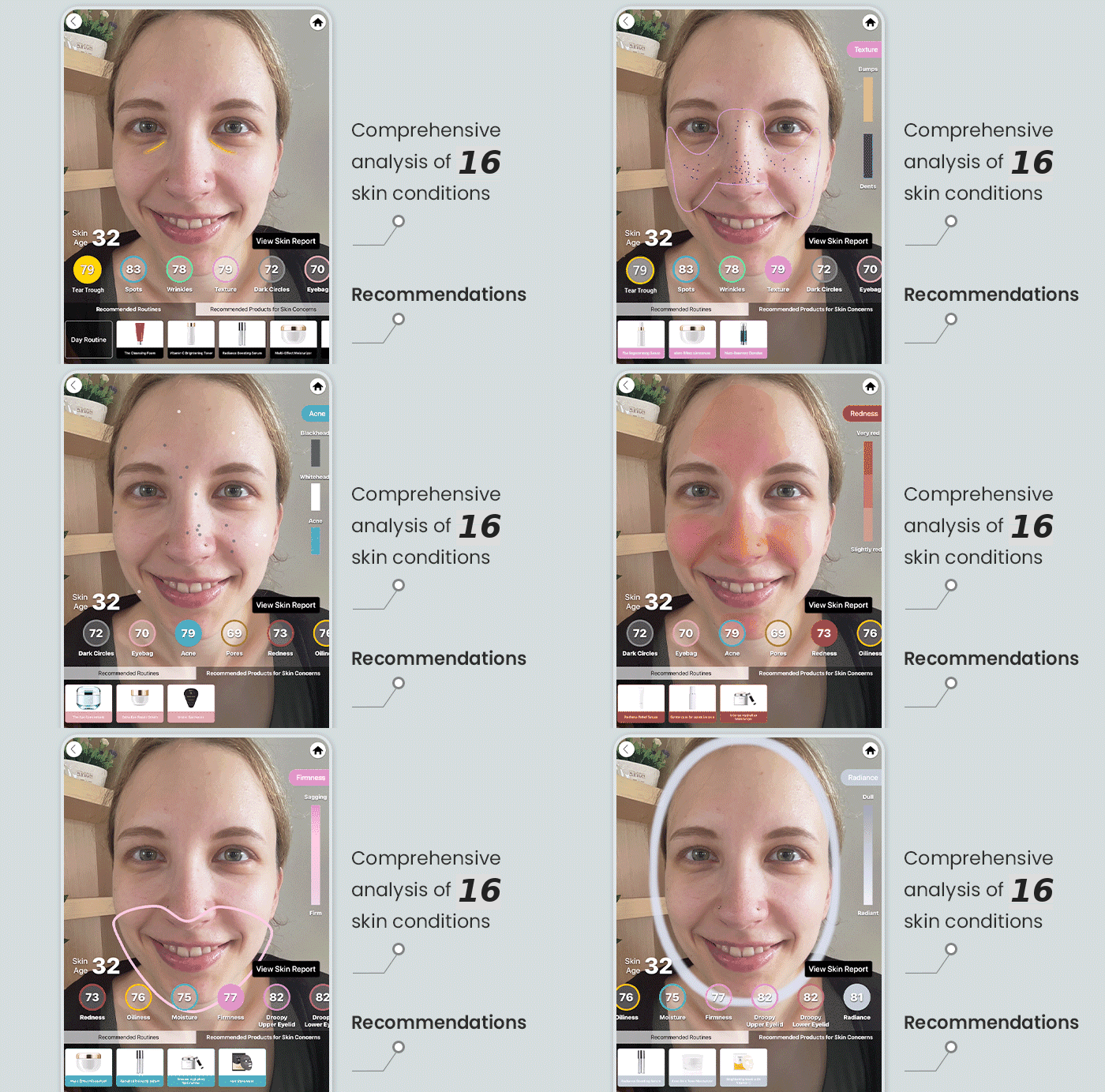
28 diagnostics across 16 skin concerns per session. Perfect Corp.'s AI Skin Diagnostic runs 28 diagnostics across 16 distinct skin concern categories in a single analysis session, including acne and blemishes, wrinkle depth and distribution, pore visibility and congestion, pigmentation and dark spots, skin tone evenness, redness and sensitivity indicators, and surface texture and hydration markers. Each is scored and spatially mapped rather than assessed globally.
Database scale and dermatologist validation. The underlying model is trained on a database of over 70 million skin assessments and has been verified by dermatologists for clinical accuracy. This dataset scale is what enables the system to perform consistently across the full range of skin tones, types, and ages — not just the demographic profiles most commonly represented in smaller training datasets.
95% test-retest reliability. In clinical testing conducted with dermatological researchers across diverse ethnicities, skin tones, age groups, and genders, the platform achieves a 95% test-retest reliability rate — meaning the same skin condition scanned across repeated sessions returns consistent severity scores. In comparative benchmarking against VISIA, the clinical-grade complexion analysis instrument used in professional dermatology practices, Perfect Corp.'s platform demonstrated accuracy at a comparable level.
Real-time product recommendations. The analysis output connects directly to a recommendation layer trained on skin condition and product efficacy data. Brands can integrate their own product catalog, enabling the system to surface specific SKUs from the brand's range rather than generic category guidance — the difference between a personalized consultation and a general suggestion.

HIPAA and GDPR compliance. Facial assessment data carries regulatory obligations that vary by jurisdiction. The platform is designed for full compliance with both HIPAA (relevant for US healthcare-adjacent deployments) and GDPR (relevant for European operations), with appropriate consent mechanisms and data governance built in.
Business Applications: Who Benefits and How
Face mapping skin analysis through AI isn't a single-use-case technology. The business context changes the deployment model and the primary value delivered.
Skincare and beauty brands (retail and e-commerce). For brands, the primary value is in connecting face mapping analysis directly to the product purchase path. A customer who receives a zone-by-zone skin assessment with specific condition findings — and sees product recommendations tied to those findings — has a fundamentally different relationship with the recommendation than one who answers a five-question quiz. The analysis provides an objective basis for the recommendation, which changes how the customer perceives both the product and the brand. Brands deploying AI skin diagnostic tools in e-commerce contexts report measurable improvement in conversion rates and average order value compared to questionnaire-based recommendation flows.
Medical spas and aesthetic clinics. In a clinical context, AI face mapping serves primarily as a consultation support and documentation tool. Clients who complete a skin assessment at intake give the practitioner a structured, quantified baseline before the consultation begins — which compresses the information-gathering portion of the appointment and allows the practitioner to focus on treatment planning. The documented baseline also creates a reference point for tracking treatment outcomes over time, which is a commercially significant capability: clients who can see measurable improvement are substantially more likely to continue treatment protocols and refer others.
Dermatology clinics. For dermatologists offering cosmetic skincare alongside clinical practice, AI skin analysis handles the cosmetic assessment work that doesn't require clinical expertise — freeing practitioner time for complex cases and improving the quality and consistency of cosmetic consultations. The HIPAA-compliant data handling is a requirement, not a feature, in this context.
Cosmetics formulation and product development teams. At the brand level, aggregate anonymized skin analysis data from real customer assessments is a product development resource. Understanding which skin concerns are most prevalent in a specific customer demographic, or how concerns shift seasonally, informs product line decisions with data that market research surveys can't easily replicate.
"The most underutilized aspect of AI face mapping in beauty retail is the longitudinal data. Brands that treat each scan as a one-time transaction are leaving significant value on the table. The real business intelligence is in what changes over time — and what that tells you about product efficacy and customer behavior." — Beauty retail technology analyst
Why Accuracy and Compliance Are Non-Negotiable
For brands considering AI face mapping skin analysis, two dimensions of platform evaluation go beyond feature comparison: accuracy and regulatory compliance. Both carry consequences significant enough that they warrant explicit assessment rather than assumed adequacy.
Accuracy across diverse demographics. As noted above, the 95% test-retest reliability rate achieved through cross-demographic clinical research is the benchmark that separates professional-grade platforms from consumer tools. For brands with multicultural customer bases — which describes most large beauty retailers — performance gaps on deeper Fitzpatrick types are both a customer equity issue and a business risk. A platform that performs significantly less accurately on darker skin tones will deliver lower-quality consultations to a meaningful portion of the customer base, which erodes trust rather than building it.
Data governance and privacy compliance. Facial analysis data is biometric data. In the United States, Illinois BIPA and several other state-level frameworks impose specific requirements around consent, storage, and deletion of biometric identifiers. GDPR in Europe adds further obligations around data subject rights and cross-border transfers. Brands deploying AI skin analysis need platform-level compliance support, not just a general data privacy policy. HIPAA compliance is specifically relevant for any deployment in a healthcare-adjacent context — medical spas, dermatology clinics, or any setting where the analysis is used to inform treatment decisions.
"Biometric data governance isn't a back-office concern anymore — it's showing up in customer trust conversations. Brands that can clearly explain how skin assessment data is handled, stored, and protected have a measurable advantage with privacy-conscious consumers." — Digital health compliance consultant
Choosing the Right AI Skin Analysis Platform
For businesses evaluating AI face mapping and skin analysis platforms, the feature list matters less than how the system performs under real operating conditions and how it integrates with existing workflows.
Key evaluation dimensions:
Analysis coverage and depth. How many skin concerns does the system assess? Does it provide zone-specific findings or only global scores? Does the face mapping cover lateral views or only frontal capture? The answers determine whether the output supports a genuinely useful consultation or a surface-level one.
Image quality management. How does the platform handle poor capture conditions — low lighting, off-angle positioning, varying camera quality? Real-time capture validation, as described above, is the more reliable approach than post-hoc image quality scoring.
Recommendation engine quality. Can the platform connect analysis outputs to specific SKUs from the brand's own product catalog? Is the recommendation logic trained or rules-based? Trained models that incorporate product efficacy data produce meaningfully better recommendations than lookup tables.

Integration flexibility. SDK support for iOS, Android, and web environments; white-label UI customization; and clean API documentation are baseline requirements for enterprise deployment. Brands should also evaluate how algorithm updates are delivered and what version transition support looks like.
Compliance certification. HIPAA and GDPR compliance should be documentable, not just claimed. Request specifics on consent mechanisms, data storage architecture, retention policies, and any relevant certifications.
Perfect Corp.'s AI Skin Diagnostic addresses each of these dimensions: 16-concern assessment with 180-degree spatial coverage, real-time capture validation, a trained recommendation engine with brand catalog integration, enterprise SDK and API support, and documented HIPAA and GDPR compliance.
Conclusion
Face mapping has always represented something clinically sound: the idea that skin should be understood spatially, zone by zone, rather than assessed as a uniform surface. What AI skin analysis adds is the ability to execute that idea consistently, at scale, with documented accuracy — and to connect the findings directly to actionable product and treatment recommendations.
For skincare brands, med spas, and dermatology clinics, the practical question isn't whether AI face mapping skin analysis has business value. The evidence on consultation quality, conversion improvement, and client retention is clear enough that the technology has moved from differentiator to competitive baseline in the prestige and wellness segments.
The question is which platform executes it with enough accuracy, compliance rigor, and recommendation quality to deliver that value reliably in a real operating environment — and how quickly it can be integrated into existing customer touchpoints.