 Author:


Pores are one of those skin concerns that customers feel deeply but rarely understand well. They show up in consultation rooms complaining about "big pores," but their mental model of what causes them — and what can actually improve them — is usually incomplete. That gap between customer perception and clinical reality is exactly where AI pore analysis earns its value.
According to a 2024 industry survey, 21% of U.S. women cite enlarged pores as a primary skin concern — placing it consistently in the top five alongside acne, wrinkles, and uneven tone. Among Gen Z shoppers specifically, pores rank as the third most commonly cited skin concern after acne and dryness. For skincare brands and clinics, that's a significant portion of their customer base arriving at consultations with pore-related questions — and historically, very few tools to answer them with any precision.
"Pores are one of the most emotionally charged skin concerns in a consultation setting, and one of the most difficult to address credibly without objective data. Customers don't just want a recommendation — they want to see that you've actually assessed their skin." — Aesthetic Industry Consultant
This article focuses specifically on what AI-driven pore analysis can do, how it fits into a broader skin analysis workflow, and where it genuinely improves consultation outcomes.
Why Pores Are Difficult to Assess Without AI
The challenge with pore assessment isn't that it's complicated — it's that it's highly subjective when done visually.
A trained aesthetician can observe pore congestion and general pore visibility under good lighting. But translating that observation into a consistent, repeatable assessment is difficult. Two practitioners looking at the same patient may categorize pore severity differently. The same practitioner may assess differently on different days, under different lighting, or depending on how much time is available for the consultation.
A 2024 comparative analysis published in the Journal of Cosmetic Dermatology examined the performance of AI pore detection tools across all Fitzpatrick skin phototypes, assessing concordance with both a gold-standard imaging device and a board-certified dermatologist's assessment. The study found that well-calibrated AI models showed strong concordance with dermatologist evaluations — and that performance varied meaningfully by skin phototype, reinforcing the importance of diverse training datasets.
This matters operationally. A skincare brand or clinic deploying AI pore analysis needs to know that the tool has been validated across the demographic range of their actual customer base — not just on a narrow phototype subset.
The VISIA Skin Analysis System, widely used in dermatology and esthetic practices, evaluates eight skin characteristics including pores, using cross-polarized and UV lighting to measure both surface and subsurface conditions. Consumer-facing AI systems like Perfect Corp.'s approach the same goal through camera-based deep learning — optimized for accessibility and scale rather than clinical hardware dependency.
What AI Pore Analysis Actually Measures
It's worth being precise about what "AI pore analysis" means technically, because the term covers a range of capabilities.
At the basic level, AI pore detection identifies visible pore openings on the skin surface, estimates their size, and maps their distribution across facial zones — typically differentiating between the T-zone (where oil production is highest and pores tend to be most enlarged) and the cheek area (where different congestion patterns appear).
More sophisticated implementations go further:
Pore type differentiation. Not all pore concerns are the same. Blackheads (open comedones where oxidized sebum darkens at the surface), whiteheads (closed comedones where sebum is trapped beneath), and simply enlarged but unclogged pores each represent different underlying conditions and call for different product and treatment recommendations. Visual assessment frequently conflates these. AI analysis using trained image recognition can distinguish between them at a parameter level.
Zone mapping. Pore size and congestion are not uniform across the face. AI analysis can break the assessment down by facial zone, which is clinically useful — a patient with congestion concentrated in the nose and inner cheek area likely has a different sebum regulation pattern than one with diffuse pore enlargement across the whole face.
Severity scoring. Rather than a binary "pores are an issue / not an issue," AI systems can produce a percentile or severity score that places the individual's pore condition in context. This is useful for tracking improvement over time — a before/after treatment comparison is far more compelling with a scored baseline than with subjective before/after photos.
Integration within multi-parameter skin analysis. This is where the real clinical and commercial value compounds. Pore condition doesn't exist in isolation — it correlates with hydration levels, sebum production, texture irregularity, and in some cases redness or early acne activity. A cloud-based AI system developed for dermatological skin analysis — cited in the Journal of Cosmetic Dermatology — processes factors including moisture, oil, sensitivity, skin color, pore size, and distribution simultaneously, using this multi-factor profile to generate tailored product recommendations. When pore analysis is one parameter within a full skin analysis rather than a standalone assessment, the resulting recommendations are more accurate and more defensible.

"Pore analysis in isolation tells you part of the story. Pore analysis alongside hydration, texture, and sebum data tells you something clinically actionable." — Cosmetic Dermatology Researcher
What Causes Enlarged Pores: The Clinical Picture
Customers tend to ask "how do I minimize my pores?" without understanding what's driving their specific pore concern. That distinction matters for product and treatment recommendation accuracy.
Sebum production and congestion is the most common driver of visible pore enlargement. When a follicle produces more sebum than can clear naturally, the opening stretches to accommodate the buildup. This is why oily skin types and T-zone areas are most commonly affected.
Loss of skin elasticity with age changes how pores appear even without congestion. Collagen and elastin support the skin structure surrounding each follicle — as this support diminishes, pores become more visible not because they're larger, but because the surrounding skin no longer holds them tight. This is a different problem than sebum-driven congestion, and it calls for different interventions.
UV damage accelerates both processes. Cumulative sun exposure degrades collagen and thickens the stratum corneum, both of which worsen pore appearance. Customers concerned about enlarged pores who aren't using consistent broad-spectrum protection are working against themselves regardless of what else they apply.
Genetics sets the baseline — follicle size and sebum production rate are substantially heritable. This is worth communicating to customers who expect pore treatments to produce dramatic size reduction: the realistic goal is optimizing the condition of existing pores, not permanently altering their structure.
Understanding which combination of these factors is driving a particular customer's pore concern is what makes an AI skin analysis consultation meaningfully more useful than a generic pore-minimizing recommendation. Clinical-grade AI skin analysis measures pore size and distribution patterns across different facial zones, alongside texture variations, sebum distribution across facial regions, and skin barrier function indicators — producing a profile specific enough to inform genuinely differentiated recommendations.

Treatment Mapping: Connecting Pore Analysis Output to the Right Intervention
The value of an accurate pore assessment is only realized when it connects to appropriate treatment guidance. Here's how different pore conditions map to different intervention categories:
Congestion-driven pores (blackheads, whiteheads, comedones
The first-line approach is regulated exfoliation. BHAs — salicylic acid in particular — are oil-soluble and penetrate the follicle to dissolve the sebum buildup that widens pores and creates comedones. AHAs (glycolic, lactic acid) address surface-level cell turnover and texture but don't penetrate the follicle the same way. For active congestion, the BHA distinction matters — and it's exactly the kind of recommendation that should be driven by an objective pore assessment rather than a general skin type quiz.
For professional treatment, extractions, chemical peels with salicylic or mandelic acid, and HydraFacial are the most commonly indicated approaches.
Age and elasticity-driven pore appearance
Here the intervention focus shifts from clearing congestion to rebuilding skin structure. Retinoids (retinol at the consumer level; tretinoin prescribed clinically) increase cell turnover, stimulate collagen production, and over consistent use reduce the structural laxity that makes pores appear larger. Niacinamide is a commonly included supporting ingredient that regulates sebum production and has some evidence for pore appearance improvement with regular use.
Clinically, microneedling and laser resurfacing target collagen stimulation directly. These are longer-cycle interventions with a 3–6 month result horizon — which is exactly why AI-based progress tracking (comparing baseline pore scores against post-treatment assessments) is clinically valuable.
Maintenance (optimized but non-congested pores)
For customers whose primary concern is appearance rather than active congestion, the core protocol is consistent cleansing, non-comedogenic formulation choices, and sun protection. The AI analysis output here is useful for demonstrating that the skin is performing well — which supports confidence in an existing routine and reduces unnecessary product churn.

How This Changes the Consultation for Skincare Businesses
AI algorithms for pore and skin assessment are beginning to supplant the traditional role of the "lady behind the cosmetic counter" — previously the main channel for personalized skincare guidance in department and drug store environments. That's not purely displacement; it's a shift in where expertise gets applied. Well-trained staff become more effective when they're working from a structured data output rather than starting every consultation from scratch.
For multi-location skincare retailers, the consistency argument is particularly strong. A customer visiting a flagship store should receive the same quality of pore assessment as a customer visiting a smaller location with less experienced staff. AI skin analysis standardizes the diagnostic baseline — what varies is the human guidance layered on top.
For med spas and aesthetic clinics, AI pore analysis serves a specific pre-treatment role. A patient scheduled for a pore-refining peel or laser treatment benefits from a documented baseline pore score. The post-treatment comparison — showing measurable improvement in pore size or congestion scores — gives the practitioner a defensible result to present and gives the patient concrete evidence that the treatment worked. This supports retention and referral in ways that subjective before/after photos don't.
For e-commerce skincare brands, pore analysis integrated into the purchase flow is one of the higher-signal personalization inputs available. A customer who self-reports "oily skin with large pores" may be describing a sebum issue, an age-related issue, or a congestion issue — or all three. An AI skin analysis that distinguishes between these produces a more accurate product recommendation and, downstream, better product-skin fit. Better fit means better results, fewer returns, and higher repurchase rates.
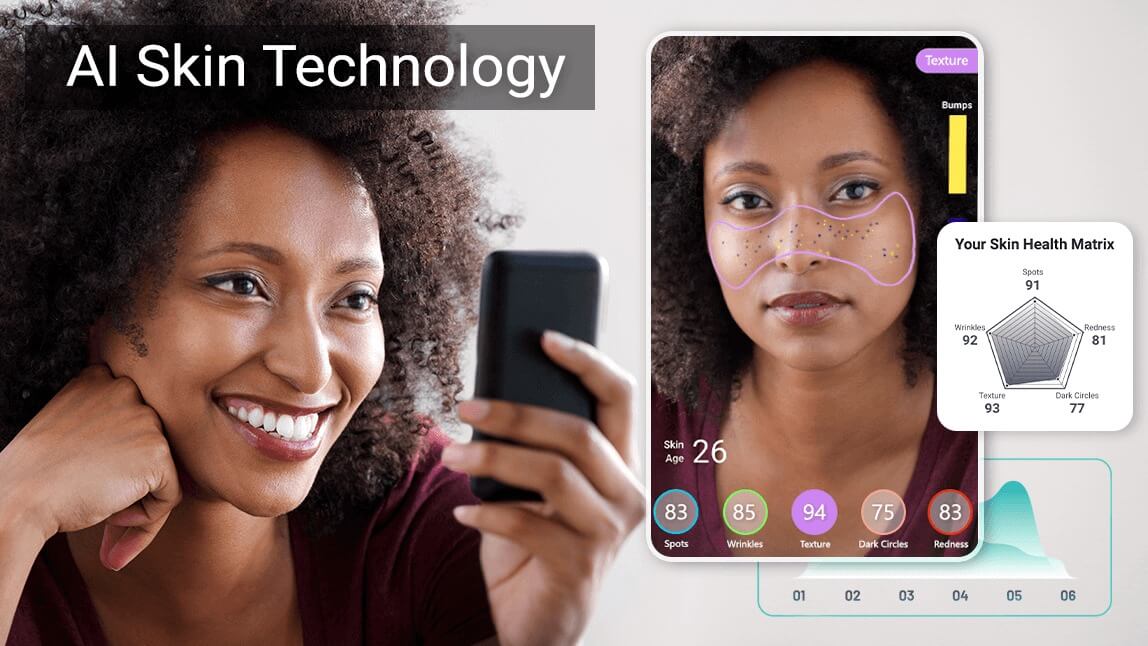
Perfect Corp.'s AI Skin Analysis addresses pore assessment as one of 15+ parameters within a complete facial skin analysis — meaning the pore data is contextualized against hydration, texture, redness, and other concurrent conditions rather than evaluated in isolation. The analysis runs in real time via standard camera input and can connect to product recommendation logic configured for specific brand catalogs.
A Note on What AI Pore Analysis Cannot Do
Managing customer expectations is part of delivering an effective pore consultation — and it's worth being equally straightforward with business clients evaluating AI skin analysis tools.
AI pore analysis measures what is visible in a camera-captured facial image. It does not measure sebum production rate, assess follicle depth, or detect conditions that require subsurface imaging. It is a surface analysis — highly useful for the consultation and product recommendation layer, but not a replacement for clinical dermatological assessment when a patient presents with active inflammatory acne, suspected hormonal drivers, or other conditions requiring medical evaluation.

Additionally, the accuracy of pore analysis (like all AI skin analysis parameters) is sensitive to image capture conditions. Standardized lighting and capture guidance in the consultation interface meaningfully improve result consistency — this is worth evaluating in any enterprise deployment.
"The most credible thing you can tell a customer about AI pore analysis is what it measures accurately and what it doesn't. That honesty is what builds the trust that makes the recommendation land." — Skincare Technology Consultant
Connecting Pore Analysis to a Full Skin Assessment
Pore health is rarely an isolated concern. A customer presenting with enlarged pores often has concurrent texture issues, elevated sebum production, or early signs of dehydration — all of which influence the right product recommendation and treatment path.
This is why pore analysis is most valuable as one input within a comprehensive skin analysis rather than as a standalone tool. When a business can surface a customer's pore condition alongside their hydration score, texture assessment, and spot distribution in a single 60-second scan, the resulting consultation is qualitatively different from one that addresses pore concerns in isolation.
For skincare brands and clinics evaluating AI skin analysis infrastructure, pore detection capability is a useful diagnostic signal in itself — but the real question to ask is how that parameter integrates with the full diagnostic profile and how easily the output connects to your product catalog and consultation workflow.
Explore Perfect Corp.'s AI Skin Analysis to see how pore assessment sits within a complete 15-parameter skin analysis — or contact the team to discuss integration options for retail, e-commerce, or clinical environments.