
Investors
Enterprise
Demo Store
TRY-ON
BlogGeneral
Face Shape Filter: How to Find Face Shape Accurately in 2 Seconds (2026)
Face Technology

Face Shape Filter: How to Find Face Shape Accurately in 2 Seconds (2026)

May 13, 2026 · 3 minutes read
face analysis

Traditionally, determining face shape involved manual measurements, but with the advancement of technology, AI Face Shape Detection has emerged. This article will show you how to identify your face shape with a face shape filter in one click, and how the AI tech benefits beauty industry.

Table of Contents


What is a Face Shape Filter, and Why is it Suddenly Everywhere?

A face shape filter is an AI-powered camera effect that doesn't just slap a flower crown on your head, it actually measures your face. Under the hood, it analyzes dozens of facial features, calculates the ratios between your hairline, cheekbones, jaw, and chin, then tells you which of the classic face shape categories you fall into. The filter part is mostly UX sprinkle. The real work is computer vision powered by deep learning algorithms.

If your feed has been flooded with friends posting screenshots of their "oval-coded" or "diamond-jawline" results from a face shape filter, that is not a coincidence. Beauty searches for face shape filter tools have surged in the US over the past 18 months as TikTok creators turn classification into content, and as brands like glasses retailers, wig makers, and skincare labels build face shape filter recommendation engines into their checkout flows. Translation: the filter is having a moment, but the business case is having a decade.

face shape filter

Face Shape Filter Demo=

How Does an AI Face Shape Filter Work?

Forget the marketing fairy dust. Every face shape filter, whether it lives in a TikTok effect, a glasses retailer's product page, or a salon's iPad app, runs through roughly the same four-step pipeline that makes the face shape filter technology so powerful.

  1. Face detection. The model finds the face inside the frame and crops a bounding box.
  2. Facial analyzing. A neural network analyzes on the eyes, brows, nose, lips, jaw, and hairline.
  3. Analyze ratios. The system measures forehead width vs. cheekbone width vs. jaw width vs. face length, and looks at jaw angle sharpness.
  4. Classification. Those ratios are matched against trained patterns for the face shape filter and returned as a label (and usually a confidence score).

Which Facial Analysis Does the AI in a Face Shape Filter Actually Track?

Consumer apps (like most free face shape filter tools) usually rely on basic analysis set. Professional-grade face shape filters used by beauty brands push that into the professional level of range, with separate models for the jawline contour. More points in a face shape filter means smoother detection on partial profiles, occluded faces (hello, bangs), and challenging lighting, which is exactly why a salon's site shouldn't be running on the same face shape filter skeleton as a free novelty app.

face shape detector comparison

How Accurate is a Face Shape Filter Compared to a Human Stylist?

Independent beauty-tech benchmarking generally puts strong face-shape filter models in the high 80s to low 90s for top-1 accuracy on clean front-facing images, which actually beats the inter-rater agreement between two human stylists looking at the same face. Where a face shape filter still slips: heavy hair coverage on the forehead, dramatic head tilt, or low-light selfies. Tell users to pull their hair back. The face shape filter will thank you.

Input QualityTypical Face Shape Filter AccuracyBiggest Failure Mode
Front-facing, bright, hair pulled back~90–95%Borderline oval vs. oblong
Front-facing, indoor lighting, bangs~80–88%Forehead width misread by face shape filter
3/4 angle, normal lighting~70–80%Jaw width misread
Side profile, harsh shadows<65%Face features drift in face shape filter

Face shape filter accuracy by input quality

If you're a brand thinking about embedding a face shape filter on your site, the lesson is simple: pretty UI is fine, but the model behind the curtain is what decides whether a customer trusts the recommendation. See how the Perfect Corp. AI Face Analyzer benchmarks across these scenarios.


What Are the 6 Face Shapes a Face Shape Filter Can Detect?

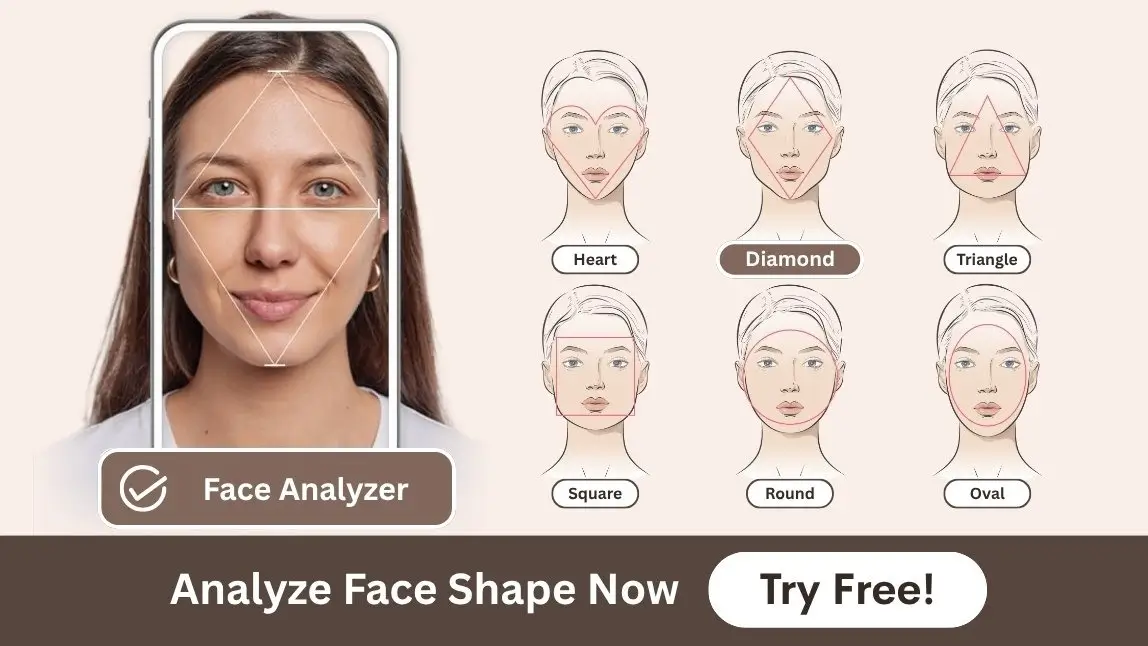
Face shape filters classify faces into six primary buckets. Here's what each looks like, and how a face shape filter identifies them:

1. Oval

oval face shape

Length exceeds width. Cheekbones are the widest point. Forehead and jawline are soft and balanced. A face shape filter will identify this as the "universal" shape because almost anything works on an oval.

2. Round

round face shape

Width and length are nearly equal. The face shape filter detects a fuller, rounder appearance with softer angles — the kind that photographs well straight-on but where a face shape filter might slightly overestimate width.

3. Square

square face shape

Strong, angular jaw and broad forehead, roughly equal in width. A face shape filter looks for sharp geometry and near-equal proportions across the face shape zones.

4. Heart

heart face shape

Wider forehead, narrow, pointed chin. A face shape filter's landmark algorithm flags when the face widens dramatically at the cheekbone and tapers sharply below.

5. Oblong

oblong face shape

Long face with narrow width relative to length. A face shape filter measures the vertical extent and flags length-to-width ratios exceeding typical boundaries.

6. Diamond

diamond face shape

Narrow forehead and jawline, prominent cheekbones. A face shape filter detects when cheekbone width significantly exceeds forehead and jaw width.


How Accurate is the TikTok Head Shape Filter?

tiktok face shape filter

TikTok's viral head shape filter is fun, shareable, and wildly inconsistent. A face shape filter on TikTok is built for entertainment, not accuracy. It will cheerfully tell you you're "diamond-coded" in one photo and "heart-coded" in another if you change your angle or lighting, which is why you've probably seen friends post dramatically different face shape filter results on their own faces.

The TikTok face shape filter prioritizes speed (sub-50ms inference to keep the camera smooth) and visual flash (animated results, trending text overlays) over the statistical rigor you'd want if you were, say, recommending a $400 pair of glasses. For a styling or shopping decision, a beauty-grade face shape filter will give you a more stable answer.


What's the Best Free Face Shape Filter Online?

The YouCam Face Shape Detector is the most reliable free face shape filter available. It runs entirely in your browser, doesn't require an account, works on desktop and mobile, and uses the same face shape filter architecture that powers commercial integrations for beauty brands.

To use the free face shape filter:

  1. Visit face-analyzer.
  2. Grant camera permission (the face shape filter runs client-side; no photo is uploaded).
  3. Align your face in the frame, pull your hair back, and tap the button.
  4. Get a face shape filter result with a confidence score.

Why this face shape filter beats others: it's trained on professional beauty data, handles varied lighting better than novelty face shape filters, and often returns a "secondary shape" if your face shape geometry sits between two categories — which is much more useful than a binary result.

AI Face AnalyzerThe free face shape filter result in under one second, no signup required.

How Do Brands Embed a Face Shape Filter on Their Own Site?

A face shape filter API lets eyewear, cosmetics, and salon sites embed the same detection logic into their product pages. Instead of sending users off to TikTok, customers run a selfie through your face shape filter, get a result, and immediately see product recommendations tailored to their face shape, all without leaving checkout.

Technical Setup for a Face Shape Filter API

Here's what a face shape filter integration typically looks like:

  • API embed. Drop a script tag into your product page. The face shape filter runs in the browser; no server round-trip needed for privacy.
  • Trigger UI. A button or modal that says "Find glasses for your face shape" or similar. When clicked, the face shape filter requests camera permission.
  • Real-time result. The face shape filter returns a label (oval, round, square, etc.) plus a confidence score.
  • Product filter. Your backend queries your product DB with the face shape result and returns curated SKUs.
  • Virtual try-on (optional). Pair the face shape filter result with an eyewear try-on or hairstyle preview for maximum engagement.


How Does Your Face Shape Affect Hairstyles, Makeup, and Glasses?

The whole reason a face shape filter exists outside of social media is that the answer changes what looks good on you. Stylists have known this forever. A face shape filter just makes the recommendation portable and scalable.

Face Shape Detector v.s. Eyewear

Same six categories (detected by a face shape filter), six different shopping carts.

Face Shape (from face shape filter)HairGlassesMakeup Focus
OvalAlmost anythingMost frame shapes workLight contour, balanced everything
RoundLayered lengths past the chinAngular, rectangular framesCheekbone contour to elongate
SquareSoft waves, side partsRound or oval framesSoft blush on the apples
HeartChin-length cuts, side-swept bangsBottom-heavy frames, aviatorsBronzer on the temples
OblongVolume at the sides, blunt bangsTall, oversized framesHorizontal blush placement
DiamondChin-length with volumeCat-eye or oval framesHighlight on forehead and chin

Quick styling by face shape (detected via face shape filter), customizable.

Pair the face shape filter result with a virtual try-on, and the recommendation becomes a "buy this" moment instead of a "huh, interesting" moment.


What's Next for AI Face Shape Filter Technology?

Virtual Try On Glasses Online

Three shifts are quietly reshaping the face shape filter category in 2026:

  • On-device everything. Face shape filter models are shrinking fast enough that inference now runs in the browser without any cloud round-trip, which is a big deal for privacy-conscious beauty brands.
  • Multimodal face shape filters. Face shape rarely travels alone, a face shape filter increasingly gets bundled with skin undertone, hair density, and even brow position to produce a richer style profile.
  • Generative previews powered by face shape filters. Instead of saying "this haircut suits oval faces," tools are starting to show your own face rendered with the cut, in real time, conditioned on the face shape filter result. Face shape becomes the conditioning input rather than the headline.

For brands, the practical implication is that a "face shape filter" is no longer a standalone gimmick. It's becoming the first checkpoint of an end-to-end personalized commerce flow — which is exactly the architecture the Perfect Corp. team has been writing about.


Face Shape Filter FAQ

How can our business integrate the AI face shape detector into our existing systems?

The AI face shape analyzer have gained significant popularity and are now widely accessible through various platforms, including websites, mobile apps, in-store smart mirrors, and social media platforms like WeChat. Your business can seamlessly integrate this technology by embedding it on your website, incorporating it into your mobile applications, utilizing smart mirrors for in-store experiences, and leveraging social media for direct customer engagement. We provide comprehensive support and documentation to ensure a smooth and efficient integration tailored to your specific needs.

What industries can benefit from implementing an AI face shape detector?

Industries such as beauty and cosmetics, hairstyle, and eyewear can significantly benefit from implementing an AI face shape detector. In the beauty and cosmetics industry, the technology can provide personalized product recommendations and virtual try-on experiences, enhancing customer satisfaction and sales. Hairstyle businesses can use face shape analysis to suggest the most flattering haircuts and styles for clients, ensuring customized and professional service. Similarly, the eyewear industry can offer tailored fitting solutions and style suggestions based on face shape, improving both the shopping experience and customer satisfaction.

How accurate is the AI face shape detector in determining face shapes?

The accuracy of face shape detectors largely depends on the quality and angle of the uploaded photo. Perfect Corp's AI face shape detector addresses this by offering user-friendly guidance to help users capture photos at optimal angles for accurate results. Utilizing advanced AI technology, the engine has been meticulously trained on a diverse dataset of 100,000 faces across various genders and ethnic backgrounds. It can accurately identify over 70 facial traits and all possible color palettes, ensuring precise and reliable face shape detection.

How does the Golden Ratio of beauty enhance face shape analysis with AI?

The Golden Ratio of beauty plays a crucial role in AI face shape analysis by providing a scientifically grounded standard for evaluating facial harmony. Perfect Corp’s AI technology incorporates this principle to assess face ratios and detect unique features with unparalleled precision. By comparing a user’s facial proportions to the Golden Ratio, the AI delivers personalized insights, helping businesses in beauty, fashion, and aesthetics recommend tailored products or services that align with the customer’s natural beauty. This advanced analysis ensures accurate results and a superior customer experience, as highlighted in our blog on AI-driven face shape determination.

What is a face shape filter?

A face shape filter is an AI-powered tool that analyzes your facial geometry from a selfie and classifies your face into one of six standard shapes: oval, round, square, heart, oblong, or diamond. A face shape filter uses computer vision to map facial landmarks and calculate proportions.

Is the face shape filter accurate?

A well-trained face shape filter is typically 85–95% accurate on a clean, front-facing photo with the hair pulled back. Accuracy drops with bangs, head tilt, and harsh lighting — which is exactly why your face shape filter result on TikTok keeps changing. Professional-grade face shape filters (like the one used in the YouCam face shape filter) train on beauty industry data and handle edge cases better than novelty filters.

How does a face shape filter work?

A face shape filter runs four key steps: (1) detect the face in the frame, (2) map facial landmarks (eyes, nose, jawline, cheekbones), (3) calculate geometric ratios between forehead, cheekbones, jaw, and face length, and (4) match those ratios against trained patterns to return a face shape label. Most face shape filters complete this in under one second.

Which face shape is the most attractive?

Beauty research consistently shows there is no single "most attractive" face shape — attractiveness ratings are remarkably even across oval, heart, and square once symmetry, skin, and expression are accounted for. A face shape filter is a styling and shopping tool, not a verdict on your attractiveness.

Can AI (a face shape filter) tell my face shape from just a photo?

Yes. A face shape filter only needs one clear front-facing photo to map landmarks and classify your face shape. No video, no 3D scan, no spreadsheet of measurements required.

What is the TikTok face shape filter, and is it accurate?

The viral TikTok face shape filter is a creative effect that overlays a stylized result on top of a fast (but less precise) face classification. It's optimized for entertainment and shareability, not accuracy — which is why you often get different results from the same face shape filter effect on different days. For a styling or shopping decision, use a dedicated beauty-grade face shape filter tool instead.

Is there a free online face shape detector / face shape filter?

Yes. The YouCam Face Shape Detector is a free, online face shape filter that runs in your browser on desktop and mobile, requires no account, and is trained on professional beauty data for higher accuracy than novelty face shape filters.

What face shape do I have?

Upload a front-facing selfie with your hair tied back into any reputable free face shape filter (like YouCam) and you will get an answer in seconds, including a confidence score or secondary shape if your face shape geometry sits between two categories. If two face shape filters disagree, trust the one trained on professional beauty data rather than the one optimized for viral shareability.

How can I use a face shape filter for shopping?

Retailers that embed a face shape filter on their product pages let you run a selfie through the face shape filter, get a result, and immediately see tailored product recommendations (glasses frames, hairstyles, makeup products) that suit your specific face shape. This combines the fun of a face shape filter with actionable shopping guidance.

Can I embed a face shape filter on my website?

Yes. Perfect Corp. offers a white-label face shape filter API that works in all the major browser. The face shape filter is a lightweight embed and runs client-side, which is why many beauty and eyewear brands now offer a face shape filter as a standard feature. Contact Perfect Corp. for licensing options.

# AI/AR Makeup# Face Technology
Popular
AI Skincare
AI Skincare Analysis Technology: Major Benefits and Innova…
Partner Success
I Tried the Top 4 Pore Clogger Checkers: Results & The AI F…
AR Accessories
Retro Glasses & Sunglasses Try On Online
By using the website, you agree to our use of cookies. Head to our cookie statement to learn more about cookies and manage cookies on this website.