Author:



Disclaimer: Some images in this article may have been created or modified by AI
A diamond size chart promises a simple answer to a not so simple question: how big will this stone actually look? Carat is a weight, not a measurement, so two 1 carat diamonds can face up very differently. Cut, shape and even the width of your finger all change the picture.
So how big do 0.5 to 3 carats really look? This guide converts carat to millimeters for round and fancy shapes, then goes one step further than most charts. It shows how much of a real finger each carat size covers, from a dainty half carat to a 3 carat showstopper, and how jewelers now let shoppers see carat size on their own hand with AR virtual try-on.
In this guide:
- What does a diamond size chart actually measure?
- Round diamond size chart: how many mm is each carat?
- How big do 0.5 to 3 carats really look on a hand?
- Fancy shape diamond size chart: oval, pear, emerald and more
- Which diamond shapes look biggest per carat?
- What carat size should you choose for an engagement ring?
- Why do printed diamond size charts mislead, and what works better?
- How can jewelers turn a size chart into a sales tool?
- FAQ
What Does a Diamond Size Chart Actually Measure?
One carat equals 0.2 grams. That is it. Carat tells you how much a diamond weighs, and a size chart translates that weight into the face up measurement you actually see: the diameter of a round stone, or the length and width of a fancy shape.
The translation is approximate because cutters make trade offs. A diamond cut deep hides weight underneath where nobody sees it, so it faces up smaller. A diamond cut shallow spreads wider but can lose brilliance. That is why two stones with identical carat weight can differ by a few tenths of a millimeter, which is very visible on a finger.

Carat vs. millimeters: the quick version
- Carat is weight. Price climbs steeply with it.
- Millimeters are what the eye sees. This is what a size chart gives you.
- Spread is the industry word for how wide a diamond faces up for its weight. More spread means a bigger look for the money.
Round Diamond Size Chart: How Many MM Is Each Carat?
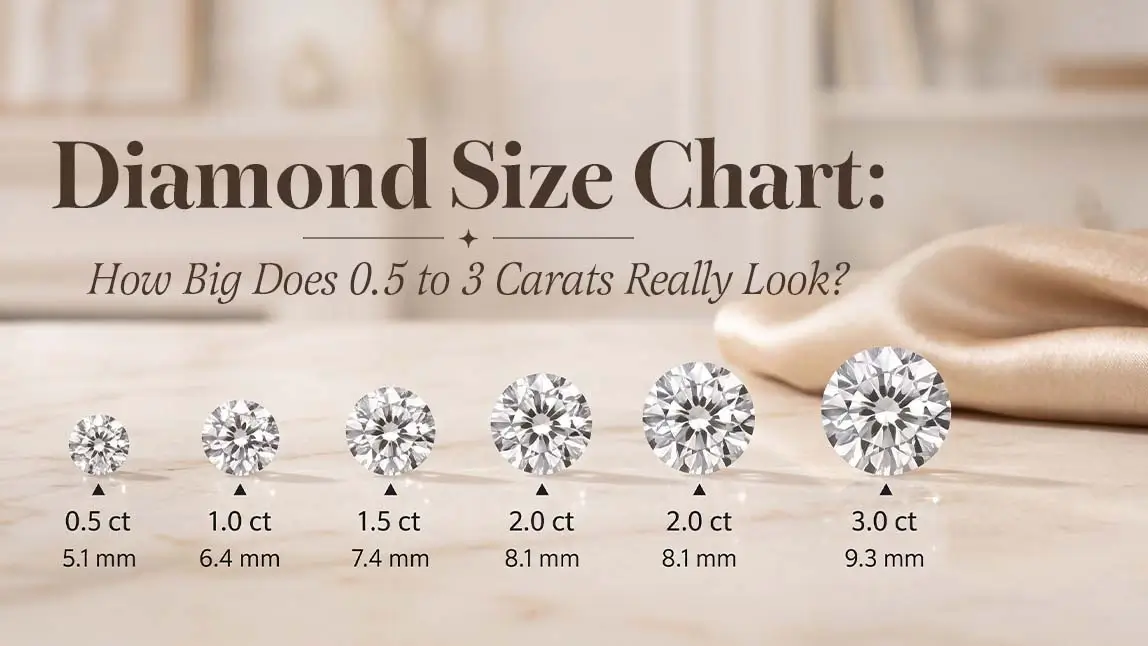
Round brilliants are the most consistent shape to measure, which makes them the baseline for every other chart. The figures below are typical diameters for well cut round diamonds.
| Carat Weight | Diameter (mm) | How It Reads on the Hand |
|---|---|---|
| 0.25 ct | 4.1 mm | Delicate, great for bands and accents |
| 0.50 ct | 5.1 mm | Subtle solitaire, everyday friendly |
| 0.75 ct | 5.8 mm | Noticeable without shouting |
| 1.00 ct | 6.4 mm | The classic engagement benchmark |
| 1.25 ct | 6.9 mm | A visible step up from 1 carat |
| 1.50 ct | 7.4 mm | Clear statement on most fingers |
| 1.75 ct | 7.8 mm | Bold, especially on slim fingers |
| 2.00 ct | 8.1 mm | Unmistakable from across a room |
| 2.50 ct | 8.7 mm | Large center stone territory |
| 3.00 ct | 9.3 mm | Covers about half of an average finger |
| 4.00 ct | 10.2 mm | Red carpet scale |
| 5.00 ct | 11.0 mm | Heirloom, museum, or very lucky |
Notice the curve. Doubling the weight from 1 to 2 carats only adds about 1.7 mm of diameter, because the extra weight spreads across width and depth. That is the single most surprising fact for most shoppers, and the reason a chart alone rarely closes a sale.
How Big Do 0.5 to 3 Carats Really Look on a Hand?
A 7.4 mm diamond means nothing until it sits on a finger. So here is the comparison most diamond size charts skip: the share of finger width each stone covers. We used the inner diameter of common US ring sizes as a stand in for finger width.

| Round Diamond | Size 4 Finger (14.9 mm) | Size 6 Finger (16.5 mm) | Size 8 Finger (18.1 mm) |
|---|---|---|---|
| 0.5 ct (5.1 mm) | 34% | 31% | 28% |
| 1 ct (6.4 mm) | 43% | 39% | 35% |
| 1.5 ct (7.4 mm) | 50% | 45% | 41% |
| 2 ct (8.1 mm) | 54% | 49% | 45% |
| 3 ct (9.3 mm) | 62% | 56% | 51% |
The takeaway is simple. The same diamond looks bigger on a smaller finger. A 1.5 carat round covers half of a size 4 finger, while it covers about 41% of a size 8 finger. If you are shopping for someone with slender hands, a 1 carat stone can deliver the visual impact many people expect from 1.5 carats.
Other things that change the on-hand look
- Band width. A thin band (around 1.5 to 2 mm) makes the center stone look larger by contrast.
- Prongs vs. bezel. Slim prongs show more diamond. A bezel adds a metal rim that frames the stone but hides a little of its edge.
- Halo. A ring of small diamonds around the center makes it read noticeably larger from a distance.
- Skin tone and metal. High contrast pairings, such as white gold on deeper skin tones, make the stone pop more.
Fancy Shape Diamond Size Chart: Oval, Pear, Emerald and More
Fancy shapes are measured by length and width. Proportions vary more than with rounds, so treat these as typical ranges rather than guarantees. Always check the actual measurements on a grading report before buying.

Want every shape in your catalog to be try-on ready? Talk to our team.
| Shape | 1 ct (mm) | 1.5 ct (mm) | 2 ct (mm) | 3 ct (mm) |
|---|---|---|---|---|
| Round | 6.4 | 7.4 | 8.1 | 9.3 |
| Oval | 8.0 x 5.5 | 9.0 x 6.5 | 10.0 x 7.0 | 11.5 x 8.0 |
| Pear | 8.5 x 5.5 | 10.0 x 6.5 | 11.0 x 7.0 | 13.0 x 8.0 |
| Marquise | 10.5 x 5.0 | 11.7 x 6.0 | 13.0 x 6.5 | 15.0 x 7.5 |
| Emerald | 7.0 x 5.0 | 8.0 x 5.5 | 8.5 x 6.0 | 9.7 x 7.0 |
| Radiant | 6.5 x 5.0 | 7.5 x 5.5 | 8.0 x 6.0 | 9.0 x 6.5 |
| Cushion | 5.7 | 6.5 | 7.3 | 8.3 |
| Princess | 5.5 | 6.3 | 7.0 | 8.0 |
| Asscher | 5.5 | 6.2 | 6.9 | 8.0 |
Square shapes such as cushion, princess and asscher list a single side length. Elongated shapes list length x width.
Which Diamond Shapes Look Biggest Per Carat?
If you want maximum visual size for your budget, shape matters as much as weight. Elongated shapes spread their weight across a longer outline, so the eye reads them as larger.

Test realistic diamond rendering in the YouCam API Playground.
- Marquise. The longest outline per carat. A 1 carat marquise can measure over 10 mm end to end.
- Pear and oval. Long, flattering on the finger, and they elongate the hand.
- Round. The brilliance benchmark. Not the biggest looking, but the most light return.
- Emerald and radiant. Step cuts and rectangles look elegant but slightly smaller than an oval of the same weight.
- Princess, cushion and asscher. Much of their weight sits in the corners and depth, so they face up the smallest per carat.
One caveat: a stone cut too shallow to fake extra spread can look glassy and dull. Size only wins when the cut still delivers sparkle.
What Carat Size Should You Choose for an Engagement Ring?
There is no correct number, but there is a correct process. Start with the hand, not the price list.
Match the stone to the finger
Use the coverage table above. Many people like a center stone that covers 35% to 50% of the finger width. Slim fingers hit that range at lower carat weights.

Compare 1, 1.5 and 2 carats on the same hand.
Factor in lifestyle
Hands on jobs, sports and daily commuting favor lower profile settings and moderate sizes. A 3 carat stone in a tall setting snags on everything.
Consider lab grown vs. natural
Lab grown diamonds are chemically identical to natural ones and typically cost far less per carat. That price gap has pushed many shoppers from 1 carat budgets toward 1.5 or 2 carat stones. The size chart is the same for both, because millimeters do not care where the diamond came from.
Read "ct tw" carefully
On three stone, halo and pavé rings, the listed weight is often carat total weight (ct tw), which adds up every diamond in the ring. A "2 ct tw" halo ring might have a 1.25 carat center and 0.75 carats of small stones. The center stone is what the size chart should measure, so always check its individual weight and millimeters on the product page or grading report.
Use the half carat trick
Prices often jump at round numbers like 1.00 and 1.50 carats. A 0.90 or 1.40 carat stone looks almost identical in millimeters but can cost noticeably less.
Why Do Printed Diamond Size Charts Mislead, and What Works Better?
Actual size diamond charts depend on your screen or printer. Zoom level, pixel density and printer scaling all change the result. A quick check: a standard credit card is 85.6 mm wide. Hold one to the screen, and if it does not match the chart's reference bar, the chart is not actual size.

Even a perfectly printed chart has a bigger problem. It shows a flat circle on white paper, not a sparkling stone on your skin. That is where AR virtual try-on changes the experience.
With AR ring virtual try-on, shoppers point a phone camera at their hand and see true to scale rings tracked in real time. They can compare carat weights side by side on the same finger, switch shapes, and try different fingers at once. Perfect Corp also offers a dedicated 1.5 carat diamond ring try-on experience that lets shoppers compare 1, 1.5 and 2 carat options directly.
Want more inspiration once the center stone is chosen? Our guide to stacking rings shows how to pair it with bands.
How Can Jewelers Turn a Size Chart Into a Sales Tool?
For online jewelers, carat size is where hesitation lives. Shoppers stare at a chart, cannot picture it, and leave to "think about it." Turning the chart into an interactive experience removes that friction.

- Pair the chart with try-on. Put a "See it on your hand" button next to every carat option.
- Add a virtual ring sizer. Perfect Corp's ring sizer measures the finger with the camera, so the coverage math becomes personal. Wrong sizes are a leading cause of costly ring returns.
- Turn 2D photos into 3D. Brands can build try-on assets from existing product images or 3D files, without a full 3D studio pipeline.
- Read the analytics. Track which carat weights and shapes shoppers try most, then merchandise accordingly.
Perfect Corp powers AI and AR experiences for 800+ beauty and fashion brands, across web, mobile apps and in-store displays. Contact Perfect Corp. for a demo to see ring try-on running on your own catalog.
Diamond Size Chart FAQ
How many mm is a 1 carat diamond?
A well cut 1 carat round diamond measures about 6.4 mm across. A 1 carat oval is roughly 8 x 5.5 mm, and a 1 carat princess is about 5.5 mm per side.
How many mm is a half carat diamond?
A 0.5 carat round diamond is about 5.1 mm in diameter. On an average size 6 finger it covers roughly 31% of the finger width.
How many mm is a 2 carat diamond?
About 8.1 mm for a round. That is only 1.7 mm wider than a 1 carat round, even though it weighs twice as much.
How many mm is a 3 carat diamond?
Roughly 9.3 mm for a round brilliant, which covers about half the width of a size 8 finger and more on smaller fingers.
Is a 1 carat diamond big?
On most hands, a 1 carat round reads as a classic, clearly visible engagement stone. On a size 4 or 5 finger it can look surprisingly large, covering over 40% of the finger width.
Does a diamond look bigger on smaller fingers?
Yes. The stone's millimeters stay the same, but it covers a larger share of a narrow finger. That is why the same 1.5 carat diamond can look dramatic on one hand and moderate on another.
Which diamond shape looks biggest for its carat weight?
Marquise, pear and oval shapes usually face up largest per carat. Princess, cushion and asscher shapes tend to look the smallest because more weight sits in their depth and corners.
Is a 6 mm diamond 1 carat?
Not quite. A 6 mm round usually weighs about 0.80 to 0.85 carats. You need about 6.4 mm for a full carat in a well cut round.
How can I see what a carat size looks like on my hand?
The most accurate way online is AR virtual try-on, which places a true to scale ring on your hand through your phone camera. Try it in Perfect Corp's ring sizer and try-on demo.