Author:



Disclaimer: Some images in this article may have been created or modified by AI
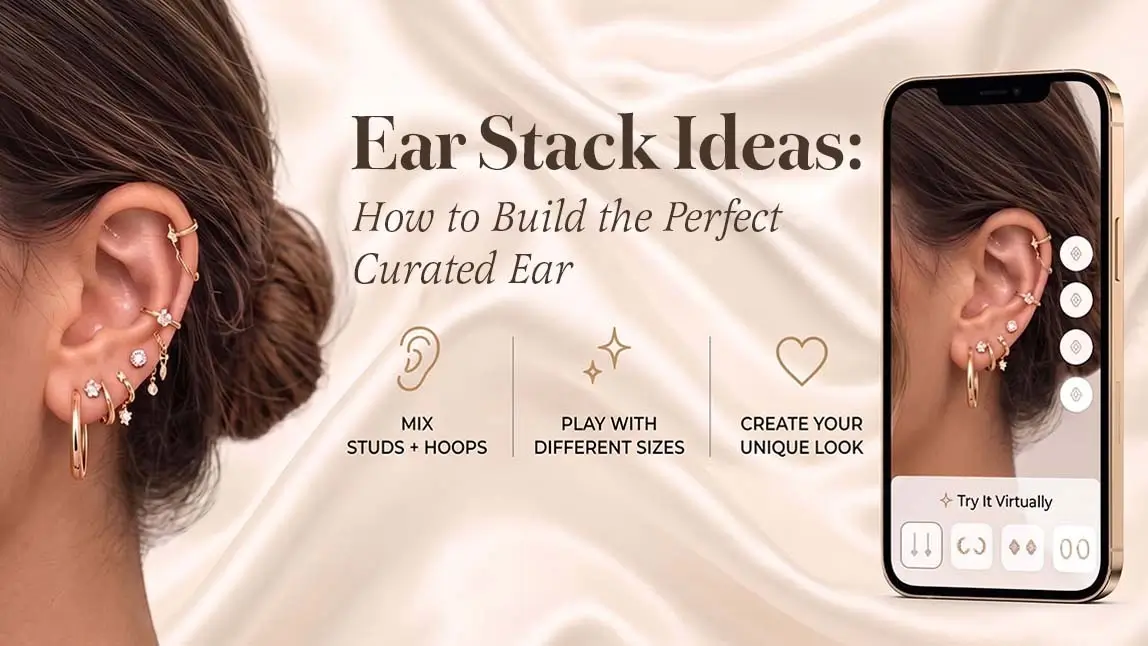
One earring per ear is officially a minimalist choice. The ear stack, also called the curated ear, has turned the whole ear into a canvas: huggies climbing the lobe, a tiny stud on the helix, a cuff hugging the conch. Done well, it looks effortless. Done randomly, it looks like a jewelry box tipped over.
This guide gives you the rules, the formulas and a dozen ear stack ideas to copy, organized by how many piercings you have. It also shows how to plan a stack before you pierce, with AR earring try-on that maps every placement on your own ear.
In this guide:
- What is an ear stack?
- Which ear piercings can you stack?
- What are the rules for a great ear stack?
- Ear stack formulas: what goes where?
- 12 ear stack ideas to copy
- How do you plan an ear stack before piercing?
- What ear stack mistakes should you avoid?
- How can jewelry brands sell the stack?
- FAQ
What Is an Ear Stack?
An ear stack is a planned combination of two or more earrings worn across different piercings on the same ear. The "curated" part is what separates it from simply wearing lots of earrings. Every piece is chosen for its size, shape, metal and placement so the whole ear reads as one composition.
The trend took off because it is personal and endlessly modular. You can build it slowly, one piercing and one pair at a time, and swap pieces to move from office minimal to weekend maximal.

Which Ear Piercings Can You Stack?
Most stacks start on the lobe and climb upward into the cartilage. Knowing the names helps you plan and talk to your piercer.
| Placement | Where It Is | Stack Role |
|---|---|---|
| First lobe | Center of the earlobe | The anchor, your largest piece |
| Second and third lobe | Above the first lobe hole | Graduated studs and huggies |
| Upper lobe | Top edge of the lobe | Bridges lobe and cartilage |
| Helix | Outer upper rim | Delicate studs, small hoops |
| Forward helix | Front rim near the face | Tiny studs in a vertical line |
| Flat | Flat area inside the upper rim | A single decorative stud |
| Conch | Center bowl of the ear | A stud or a wraparound hoop |
| Tragus | Small flap over the ear canal | Micro stud accent |
| Rook and daith | Inner ridges of the ear | Curved bars and small rings |
What Are the Rules for a Great Ear Stack?
Stylists and piercers tend to agree on six principles. Learn them, then break them on purpose.

- Graduate the size. Biggest on the first lobe, smaller as you move up. It creates a natural flow toward the top of the ear.
- Pick an anchor. One hero piece, like a drop, a bold hoop or a large pearl, gives the stack a focal point.
- Repeat something. A shared metal, stone or shape across three pieces makes even a mixed stack look intentional.
- Mix shapes. Combine round studs, hoops and one unexpected shape (a star, a bar, a marquise) for rhythm.
- Leave negative space. An empty hole or gap lets each piece breathe. Not every piercing needs jewelry every day.
- Embrace asymmetry. Your ears do not need to match. A full stack on one side and a single stud on the other is a modern classic.
Ear Stack Formulas: What Goes Where?
If you want a shortcut, use these proven combinations as a starting point. Sizes follow the graduation rule, so double check them against our earring size chart.
| Piercings | Formula | Vibe |
|---|---|---|
| 0 extra (lobe only) | Lobe stud + ear cuff on the mid rim | Stack look, no new piercing |
| 2 | Lobe 1: 20 mm hoop. Lobe 2: 4 mm stud | Clean and classic |
| 3 | Lobe 1: drop. Lobe 2: 10 mm huggie. Lobe 3: 3 mm stud | Polished staircase |
| 4 | Lobe trio as above + helix 3 mm stud | Balanced with a top accent |
| 5 and up | Lobe trio + conch hoop + helix or forward helix studs | Full curated ear |

12 Ear Stack Ideas to Copy
Pick by personality, not just by piercing count. Each idea notes the minimum number of piercings you need.
1. The Everyday Gold Staircase (3 piercings)
A 20 mm gold hoop, a 10 mm huggie and a 3 mm ball stud. It is the stack that goes with everything, including gym clothes.

Try this stack on your own ear.
2. Diamond Gradient (3 piercings)
Diamond studs in 5, 4 and 3 mm climbing the lobe. Quiet luxury that photographs beautifully.

3. Pearl and Gold (2 piercings)
A 7 mm pearl stud on the first lobe and a fine gold huggie above it. Soft, classic and wedding guest approved.

Not sure which pearl size? See the earring size chart.
4. Celestial Scatter (4 piercings)
Star and moon studs across lobe and helix, plus one tiny diamond huggie. Playful but still grown up.

5. Chunky Hoop Edit (2 piercings)
A 4 mm thick gold hoop with a matching thick huggie. Two pieces, maximum attitude.

See how brands let shoppers try bold hoops virtually.
6. Pavé Everything (3 piercings)
Pavé huggies in graduated sizes. Pure sparkle with zero effort in the morning.

7. Birthstone Story (3 piercings)
Colored stone studs for family birthstones, tied together by one metal. Personal and gift friendly.

Build stack try-on with the YouCam API.
8. The No New Piercing Stack (1 piercing)
A lobe stud, an ear cuff on the mid rim and a second cuff higher up. All the curated look, none of the healing time.

9. Mixed Metal Done Right (3 piercings)
Gold, silver and a two tone huggie in the middle that bridges both metals. The two tone piece is the secret.

Map every placement with the ear piercing diagram API.
10. Helix Line (4 piercings)
A simple lobe stud with three micro studs running up the helix rim. Graphic and modern.

11. Conch Statement (2 piercings)
A small lobe stud and a bold conch hoop as the hero. Unexpected and editorial.

Bring curated ear try-on to your store. Book a demo.
12. Full Curated Ear (5+ piercings)
Drop on lobe 1, huggies on lobes 2 and 3, a flat stud, a tragus micro stud and a forward helix pair. The final boss of ear stacks.

How Do You Plan an Ear Stack Before Piercing?
Piercings are permanent decisions and cartilage can take months to heal. Planning first saves both regret and money.
- Study your ear. Rim thickness and lobe size determine which placements and sizes work for you.
- Choose the final look first. Work backward from your dream stack so every new piercing has a place in it.
- Try it virtually. With AR ear piercing try-on, you can place earrings across 13 lobe and cartilage positions on your own ear in real time, then save the full stack layout.
- Bring the plan to your piercer. A screenshot of your virtual stack is the clearest brief a piercer can get.
- Build in phases. Pierce a few spots at a time, let them heal, then add the next layer.
What Ear Stack Mistakes Should You Avoid?
Most stacks that look "off" break the same few rules.

See how earring try-on works across web, app and in-store mirrors.
- Same size everywhere. Five identical studs read as a pattern, not a stack. Vary the scale.
- Too many heroes. Two big statement pieces compete. Choose one.
- Ignoring gauge. Cartilage jewelry is often thicker than fashion posts. Check before you buy.
- Heavy pieces on fresh piercings. Wait for full healing before hanging drops or large hoops.
- Sleeping in a full stack. Large hoops and cuffs snag on pillows. Keep flat backs for bedtime.

Test graduated sizes on your own ear in the demo.
How Can Jewelry Brands Sell the Stack?
For jewelers, the ear stack is a basket builder. Shoppers who plan a stack buy multiple pieces, and they come back to add the next one. The challenge is that a product page shows one earring on a white background, while the customer is imagining five on their own ear.
- Sell curated sets. Bundle ear stack formulas as ready made sets with one "Try the stack" button.
- Enable multi placement try-on. Let shoppers place several SKUs across different piercings at the same time.
- Scale the catalog fast. Build try-on assets from a single 2D product photo, without manual 3D modeling.
- Learn from the data. Track the most tried placements and metal preferences, then merchandise around them.
Perfect Corp's AR earring solution powers these experiences on websites, mobile apps and in-store smart mirrors, backed by AI and AR technology trusted by 800+ beauty and fashion brands. Developers can also start with the AI ear piercing diagram API. Contact Perfect Corp. for a demo to bring ear stack try-on to your store.
Ear Stack FAQ
How many earrings should be in an ear stack?
Two is the minimum, and three to five is the sweet spot for a curated look. Beyond that, negative space and graduated sizing matter more than the count.
What is a curated ear?
A curated ear is an intentionally designed ear stack, where each earring and piercing placement is chosen to work together as one look.
Do both ears need to match?
No. Asymmetrical stacks are one of the most popular ways to wear the trend. Many people keep a full stack on one side and one or two pieces on the other.
Can you mix gold and silver in an ear stack?
Yes. Repeat each metal at least twice, or add a two tone piece in the middle, so the mix looks deliberate.
What earring goes in the second hole?
Something smaller than the first lobe earring. A 3 to 5 mm stud or an 8 to 12 mm huggie are the classic choices.
Can you make an ear stack without new piercings?
Yes. Ear cuffs sit on the cartilage without a piercing, so a lobe earring plus one or two cuffs creates a convincing stack.
What is the most popular ear stack combination?
A lobe hoop, a second lobe huggie and a small helix stud is one of the most common combinations. It is balanced, easy to wear and works with any metal.
How can I see an ear stack on my ear before piercing?
Use AR virtual try-on. Perfect Corp's earring try-on demo lets you place earrings across multiple piercing positions on your own ear in real time.