Author:



Disclaimer: Some images in this article may have been created or modified by AI
Earrings are the one accessory you almost never see on yourself while shopping. A "5 mm stud" or a "30 mm hoop" sounds precise, yet most people cannot picture either. The result is tiny studs that disappear or hoops that swing into your scarf.
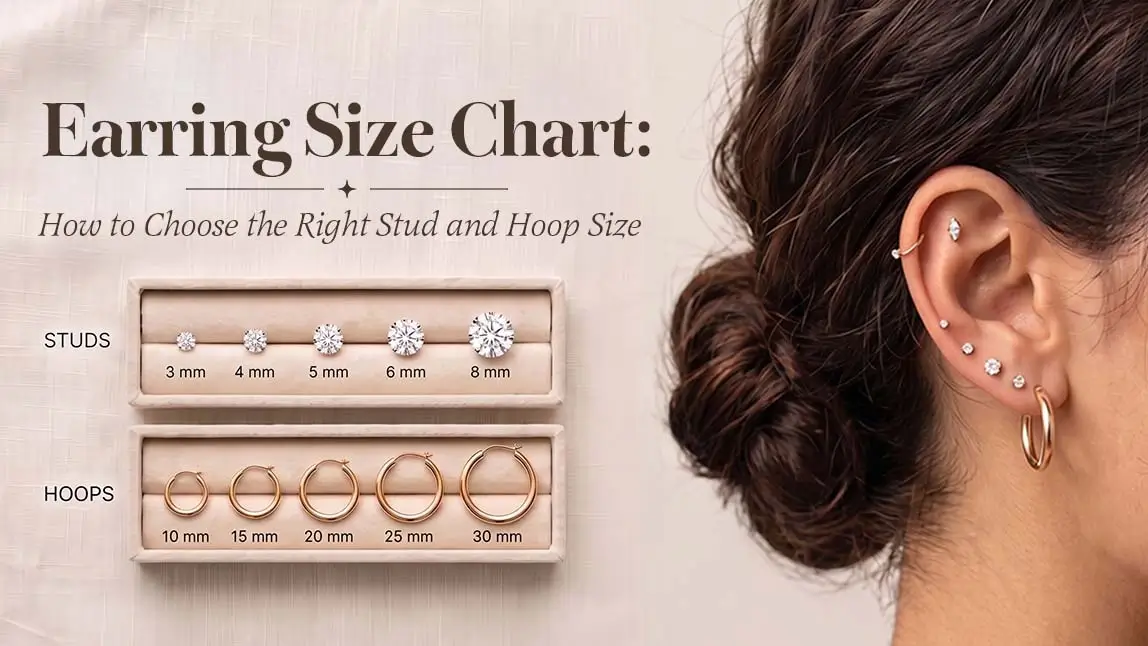
This earring size chart shows you how to choose the right stud and hoop size. It translates millimeters into real life: stud sizes, diamond stud carat weights, hoop diameters, drop lengths and post gauges, plus which size suits each piercing, face shape and lifestyle. We close with how AR virtual try-on lets shoppers see true to scale earrings before they buy.
In this guide:
- How are earrings measured?
- What stud earring size should you choose?
- Diamond stud size chart: how big is each carat total weight?
- Hoop earring size chart: mm to inches
- What size hoops should you get?
- How long should drop earrings be?
- What gauge are earrings? Post thickness explained
- What size earrings fit each piercing?
- Why do earring size charts fail online, and what fixes it?
- FAQ
How Are Earrings Measured?
Every earring style uses a different measurement, which is half the confusion. Here is what each number on a product page actually means.
- Studs: the diameter of the front face (the stone, pearl or disc), in millimeters.
- Hoops: usually the inner diameter, in millimeters. Some brands list outer diameter, which adds the tube thickness on both sides. Check before you compare.
- Hoop thickness: the width of the metal tube, typically 1 to 5 mm.
- Drops and dangles: total length from the top of the ear wire or post to the bottom of the earring.
- Gauge: the thickness of the post or wire that goes through the piercing. Lower gauge numbers mean thicker posts.
Pro tip: a standard pencil eraser is about 6 to 7 mm across. Hold one to your earlobe to sanity check any stud size.
What Stud Earring Size Should You Choose?
Stud sizes climb in small steps, but each millimeter changes the look more than you would expect, because the earlobe itself is small.

Compare stud sizes on your own ear in the live earring try-on demo.
| Stud Size | Look | Best For |
|---|---|---|
| 2 to 3 mm | Barely there sparkle | Cartilage, second and third lobe holes, kids |
| 4 mm | Dainty and minimal | Everyday wear, stacking, small lobes |
| 5 mm | Classic and noticeable | First lobe piercing, office wear |
| 6 mm | Polished focal point | Most popular all round size |
| 7 mm | Confident and visible | Larger lobes, evening looks |
| 8 mm | Statement stud | Pearls, events, bold single earring looks |
| 9 to 10 mm+ | Dramatic | Large pearls, cocktail studs, special occasions |

Add true to scale stud try-on to your store. Contact us.
How to choose the right stud size
- Start with the piercing. First lobe holes suit 4 to 8 mm. Second holes and cartilage look best at 2 to 5 mm.
- Match your lobe. Small lobes look balanced with 4 to 5 mm. Larger lobes can carry 7 mm and up.
- Think about wear time. For every day, 5 to 6 mm is the sweet spot. Go bigger for events.
- Stacking? Keep the largest stud on the first lobe and scale down as you move up the ear.
For pearl studs, 6 to 7 mm is the timeless default. 8 to 9 mm reads as a luxury statement, and anything above 10 mm is formal jewelry territory.
Diamond Stud Size Chart: How Big Is Each Carat Total Weight?
Here is the detail that trips up most shoppers. Diamond studs are usually sold by carat total weight (ct tw), which is the combined weight of both earrings. A "1 ct tw" pair is two half carat stones, not two 1 carat stones.

| Total Weight (Pair) | Carat Per Stud | Diameter Per Stud (Round) |
|---|---|---|
| 0.25 ct tw | 0.125 ct | about 3.2 mm |
| 0.50 ct tw | 0.25 ct | about 4.1 mm |
| 0.75 ct tw | 0.375 ct | about 4.6 mm |
| 1.00 ct tw | 0.50 ct | about 5.1 mm |
| 1.50 ct tw | 0.75 ct | about 5.8 mm |
| 2.00 ct tw | 1.00 ct | about 6.4 mm |
| 3.00 ct tw | 1.50 ct | about 7.4 mm |
| 4.00 ct tw | 2.00 ct | about 8.1 mm |
A 1 ct tw pair is the most common gift size: noticeable, wearable daily, and still within many budgets. Settings matter too. A halo or bezel adds a frame of 1 to 2 mm around each stone, which makes the stud look bigger than the diamond alone. For a deeper look at carat to mm conversions, see our diamond size chart.
Hoop Earring Size Chart: MM to Inches
Hoops cover a huge range, from huggies that hug the lobe to shoulder grazing statement rings. Sizes below are inner diameter.
| Category | Diameter (mm) | Diameter (inches) | Where It Sits |
|---|---|---|---|
| Huggie | 8 to 12 mm | 0.3 to 0.5 in | Hugs the lobe, no swing |
| Small | 12 to 20 mm | 0.5 to 0.8 in | Just below the lobe |
| Medium | 20 to 35 mm | 0.8 to 1.4 in | Mid jaw, everyday statement |
| Large | 40 to 60 mm | 1.6 to 2.4 in | Near the jawline |
| Extra large | 60 mm and up | 2.4 in and up | Below the jaw, toward the neck |

Quick conversions shoppers search for
- 10 mm = 0.39 in (classic huggie)
- 20 mm = 0.79 in (small everyday hoop)
- 30 mm = 1.18 in (the go to medium hoop)
- 40 mm = 1.57 in
- 50 mm = 1.97 in (roughly a 2 inch hoop)
- 60 mm = 2.36 in
Hoop thickness guide
- 1 to 2 mm: fine and delicate, perfect for stacking.
- 2 to 3 mm: the everyday classic.
- 4 mm and up: chunky and bold. Heavier, so better in small to medium diameters for all day comfort.
What Size Hoops Should You Get?
The right hoop depends on three things: face shape, lifestyle and how much movement you want.

See how brands deploy earring try-on on web, app and in store.
By face shape
| Face Shape | Flattering Sizes | Why It Works |
|---|---|---|
| Round | Medium hoops, long drops | Vertical lines lengthen the face |
| Oval | Almost any size | Balanced proportions handle everything |
| Square | Medium to large round hoops | Curves soften a strong jawline |
| Heart | Medium hoops, teardrops | Adds width near a narrower chin |
| Long or oblong | Huggies, studs, wide small hoops | Keeps the eye from traveling further down |
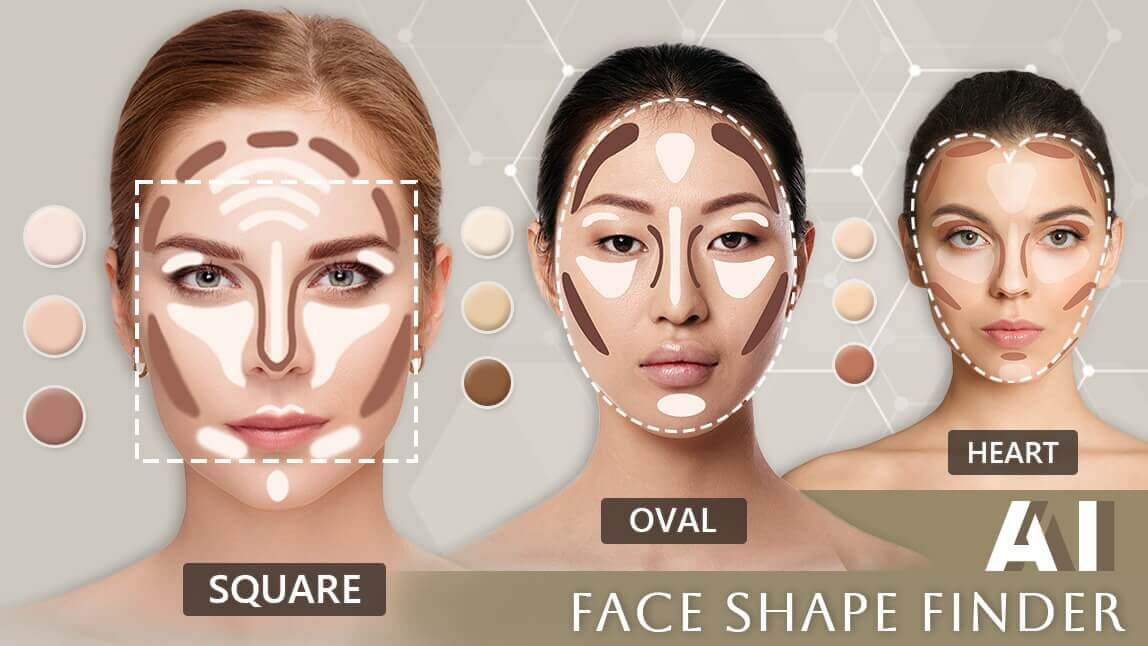
Not sure which shape you are? An AI face shape detector can tell you in seconds from a selfie.
By lifestyle
- All day wear and workouts: huggies or small hoops under 20 mm.
- Office and video calls: 15 to 30 mm hoops add polish without distraction.
- Evenings and events: 40 mm and up, or textured and pavé hoops.
How Long Should Drop Earrings Be?
Drop and dangle earrings are measured end to end. Length decides whether an earring reads as daytime or dramatic.
| Length | Inches | Effect |
|---|---|---|
| 2 to 4 cm | 0.75 to 1.5 in | Small drop, easy everyday movement |
| 4 to 6 cm | 1.5 to 2.3 in | Noticeable, ends around mid jaw |
| 7 to 9 cm | 2.5 to 3.5 in | Jawline to upper neck, statement level |
| 10 cm and up | 4 in and up | Shoulder dusters, best for updos and events |
Hairstyle matters. Long drops shine with updos and short cuts. With long loose hair, go a little bolder so the earring is not swallowed.
What Gauge Are Earrings? Post Thickness Explained
Gauge is the thickness of the post or wire. If a post is too thick it will not fit comfortably, and if it is too thin a healed piercing may feel loose.

| Gauge | Thickness | Common Use |
|---|---|---|
| 20g | 0.8 mm | Standard fashion earrings for lobes |
| 18g | 1.0 mm | Many studio lobe piercings, some cartilage |
| 16g | 1.2 mm | Typical for helix, tragus and other cartilage |
| 14g | 1.6 mm | Industrial bars and some daith or body jewelry |
If you bought jewelry from a piercing studio, ask which gauge was used. Mixing up 20g fashion posts and 16g cartilage jewelry is the most common fit complaint.
What Size Earrings Fit Each Piercing?
Placement changes everything. A 6 mm stud looks elegant on a first lobe and oversized on a tragus.
| Piercing | Typical Stud Size | Typical Hoop Size |
|---|---|---|
| First lobe | 4 to 8 mm | Any size |
| Second lobe | 3 to 5 mm | 8 to 12 mm huggie |
| Third or upper lobe | 2 to 4 mm | 7 to 10 mm |
| Helix | 2 to 4 mm | 7 to 10 mm |
| Tragus | 2 to 3 mm | 6 to 8 mm |
| Conch | 3 to 5 mm | 10 to 14 mm |
| Rook and daith | Curved bars | 8 to 10 mm |
Sizes vary with ear anatomy, so a piercer can fine tune the fit. The general rule is to scale down as you move up the ear.
Why Do Earring Size Charts Fail Online, and What Fixes It?
A chart tells you that a hoop is 30 mm. It cannot tell you whether 30 mm grazes your jaw or vanishes under your hair. Ears, faces and hairstyles vary too much for a single number to answer the real question: how will it look on me?
Build earring try-on into your app with the YouCam API.
AR earring virtual try-on answers it in real time. Shoppers turn their head in front of a camera and see true to scale earrings tracked to the ear, with realistic metal and stone rendering. Perfect Corp's solution supports 13 piercing placements across lobe and cartilage, so shoppers can test a 3 mm helix stud and a 30 mm lobe hoop together.
Why it matters for jewelry retailers
- Fewer size related returns. Shoppers commit to the right diameter the first time.
- Faster catalog setup. Try-on assets can be built from a single 2D product photo, with no 3D modeling required.
- Bigger baskets. Multi placement try-on naturally encourages shoppers to add a second or third pair.
- Everywhere your customer is. The same experience runs on e-commerce sites, mobile apps and in-store smart mirrors.
Perfect Corp powers AI and AR try-on for 800+ beauty and fashion brands. Contact Perfect Corp. for a demo to add earring try-on to your store.
Earring Size Chart FAQ
How do I know what size hoop earring to get?
Start with lifestyle. Huggies (8 to 12 mm) and small hoops (12 to 20 mm) suit daily wear, 20 to 35 mm hoops are a versatile middle, and 40 mm and up are statement pieces. Then adjust for face shape and hairstyle, or simply try sizes on virtually.
What size is a 30 mm hoop earring?
A 30 mm hoop is about 1.18 inches in diameter. It is a medium hoop that usually hangs to around mid jaw, and it is one of the most popular everyday sizes.
How big is a 2 inch hoop earring?
A 2 inch hoop is about 50 mm across. It is a large hoop that typically reaches near the jawline on most people.
Is 8 mm or 10 mm bigger?
10 mm is bigger. Every millimeter counts on studs, and the jump from 8 to 10 mm adds over 50% more surface area.
What size stud earrings are most popular?
5 to 6 mm studs are the most popular everyday size. For diamond studs, a 1 ct tw pair (about 5.1 mm per stud) is a common favorite.
Is a 4 mm stud too small?
Not at all. 4 mm is a dainty everyday size, and it is perfect for second lobe holes and stacks. On a first lobe piercing, it reads as minimal rather than tiny.
What gauge are normal earrings?
Most fashion earrings use a 20 gauge (0.8 mm) post. Piercing studios often use 18 gauge for lobes and 16 gauge for cartilage.
What size hoop fits a helix piercing?
Most helix hoops measure 7 to 10 mm in inner diameter. The exact fit depends on how far the piercing sits from the rim of the ear.
How can I see earring sizes on my own ear?
Use AR virtual try-on. Perfect Corp's earring try-on demo lets you compare sizes and placements on your own ear in real time.